From Vibe Coding to Vibe Worlding: AI Is Learning to Build Its Own 3D Worlds

If Vibe Coding transformed coding from "typing on a keyboard" to "conversing with AI," then the work I'm covering today may be doing the same thing in the domain of 3D world construction.
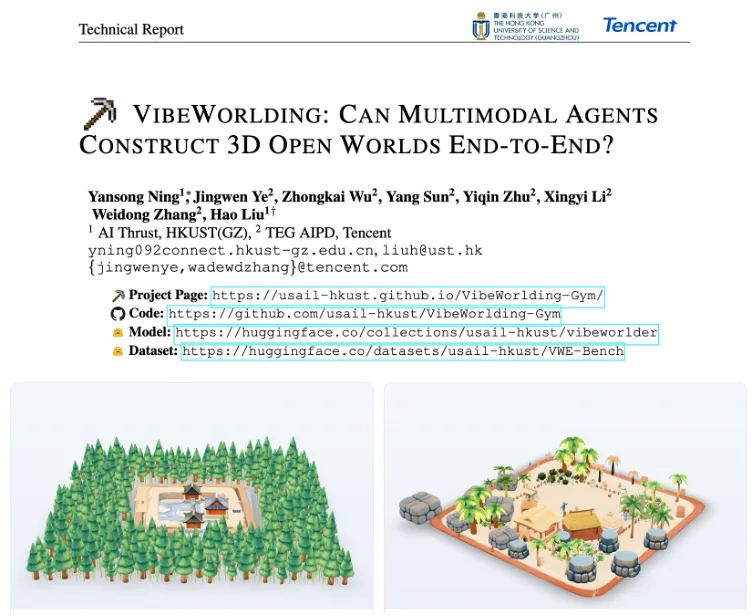
Links:
- Project page: https://usail-hkust.github.io/VibeWorlding-Gym/
- Code (sandbox & training framework): https://github.com/usail-hkust/VibeWorlding-Gym
- Dataset (VWE-Bench): https://huggingface.co/datasets/usail-hkust/VWE-Bench
- Models (VibeWorlder collection): https://huggingface.co/collections/usail-hkust/vibeworlder
A team from the Hong Kong University of Science and Technology (Guangzhou) and Tencent AI Platform has proposed VibeWorlding: a multimodal agent framework that can autonomously construct and edit interactive 3D worlds through multi-turn dialogue, tool calling, and render feedback — just like how AI agents write code. Tell it "build me a eerie desert temple" or "move the chair next to the table forward two meters," and the agent handles 3D asset retrieval, object placement, collision avoidance, and render confirmation on its own.
The core of this system isn't yet another "text-to-3D" generative model — it's an entire trainable, verifiable, reproducible benchmark and reinforcement learning framework. They've open-sourced 6,828 multimodal user queries, 2,616 high-quality 3D assets, 323 manually annotated seed 3D worlds, a complete sandbox environment, and a dual-constraint verifier. Results show that after RL training, the open-source model VibeWorlder-30B-A3B surpassed GPT-5.5 and Qwen3.8-Max on overall Pass@1, becoming the best-performing model on this task.
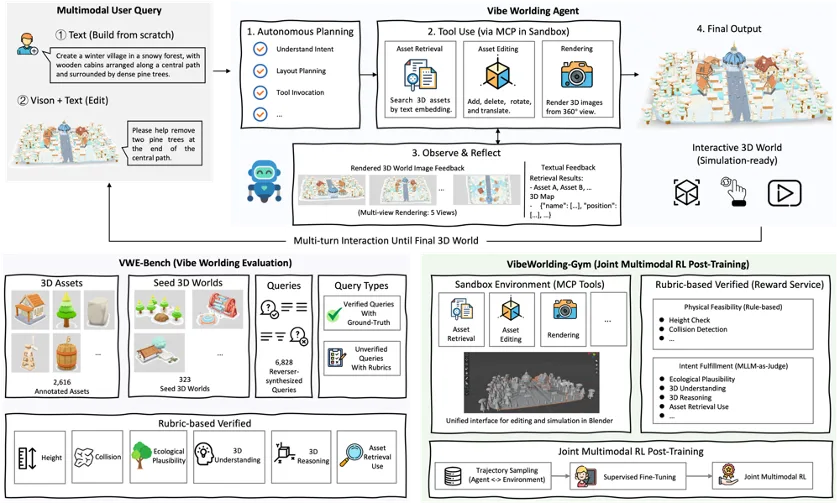
Figure 1: VWE-Bench and VibeWorlding-Gym Overview
Why Does Building 3D Worlds Need a Paradigm Shift?
Game levels, digital twins, embodied AI simulation environments — all of these depend on large amounts of interactive, editable 3D worlds, but traditional manual construction is extremely inefficient. In recent years, with the rise of multimodal large models (MLLMs), the research community has been exploring automated AI agent approaches, generally along two lines:
- Fixed Workflow: Works like SceneCraft and 3D-GPT split the construction process into a "planning → generation → review" pipeline, with a dedicated sub-agent for each stage.
- Autonomous Agentic: Works like SAGE, SceneWeaver, and SceneReVis package 3D asset retrieval, editing, and rendering as tool sets, letting the agent make autonomous decisions, interact multi-turn, and self-correct.
But both approaches share two persistent problems: first, evaluation queries are overly idealized and simple, failing to reflect the wild, ambiguous, even contradictory expressions of real users; second, nearly all frameworks are not open source, leaving the research community unable to fairly benchmark or systematically investigate whether training actually improves these underlying capabilities.
A viable 3D world must both "physically hold up" (no floating objects, no clipping) and "semantically make sense" (match user intent, coherent style). This multi-dimensional correctness is hard to achieve with either manual rules or a generic LLM judge alone — which is exactly the core problem VibeWorlding sets out to solve.
What Exactly Is VibeWorlding?
This research frames the entire "3D world construction" task as a multi-turn, multimodal, tool-integrated reasoning process: given a multimodal request (pure text description, or "existing world + edit instruction"), the agent must autonomously infer user intent, plan scene layout, call 3D tools (retrieve / add / rotate / translate / delete 3D assets), and observe the sandbox's multimodal feedback (3D map text + five-view rendered images) after each round — repeating until a complete interactive 3D world is produced.
The framework has two core components:
- VWE-Bench (VibeWorlding Evaluation Benchmark): Covers 2,616 high-quality 3D assets, 323 manually annotated seed worlds, and 6,828 inversely-synthesized user queries. It distinguishes between "verifiable with ground truth" and "open-ended scored by rules."
- VibeWorlding-Gym: A joint multimodal RL post-training framework that packages 3D asset retrieval, editing, and rendering as MCP tools, with a "dual-constraint verifier" supporting both fair evaluation and scalable RL reward computation.
How Were 6,828 Queries "Inversely" Generated?
VWE-Bench construction took a "human-machine collaboration" route in three steps:
- Step 1: High-quality 3D asset synthesis. Artists first defined names and categories for 3,148 conceptual 3D assets, used Gemini 3.1-flash-image to generate reference images, then converted them to 3D meshes using Tencent's Hunyuan3D 3.1. After quality filtering and real-scale annotation, they settled on 2,616 retrievable, cross-20-semantic-category high-quality 3D assets.
- Step 2: Seed world annotation. Professional artists manually constructed 323 "rough but functionally complete" seed 3D worlds using these assets, with asset counts ranging from 8 to 258, covering different complexity levels.
- Step 3: Inverse query synthesis. MLLMs were tasked with "reading worlds backwards" — given a world, they wrote descriptions of "how to build this from scratch" (for from-scratch tasks), critiqued the world and suggested edits (for editing tasks), or deliberately perturbed assets and described the changes to obtain edit instructions with precise ground truth.

Figure 2: VWE-Bench data samples. (a) 3D asset samples arranged by physical size; (b) seed world samples arranged by complexity
The result is six major query categories. "Precise asset-level editing" queries — which have a clear perturbation process allowing direct comparison with ground-truth maps — are classified as Verified. The remaining five categories (vague expressions, scene critique, guidance, restatement, and complex scene descriptions) that more closely mirror real user language are classified as Unverified and scored by a carefully designed Rubric via an MLLM judge.
Both "Physically Plausible" and "Semantically Correct": The Dual-Constraint Verifier
VibeWorlding defines two hard standards for whether a 3D world "passes":
- Physical feasibility verification: Pure Python geometric collision detection (objects can't clip through each other) and height checks (objects can't float) — no model judgment involved.
- Intent satisfaction verification: An MLLM judge evaluates from four dimensions: ecological plausibility, 3D understanding, 3D reasoning, and retrieval soundness — both whether the agent understood what the user wanted and whether it actually used the right tools in the right places.
For Unverified queries, all five criteria (physical feasibility plus four intent dimensions) must pass for success. For Verified queries, comparison is direct against ground-truth maps, scoring by the proportion of correctly edited 3D assets.
Building on this, the VibeWorlding-Gym training pipeline was constructed: Gemini 3.1-pro was used for cold-start SFT trajectory synthesis, then GRPO algorithm was applied for multimodal reinforcement learning under reward signals from the dual-constraint verifier — letting the agent jointly learn from both "pure text from-scratch" and "multimodal image-text editing" tasks, rather than training on a single modality as in prior work.
Results: How Did the Open-Source Model Surpass GPT-5.5?
This research conducted systematic evaluation on VWE-Bench across 8 frontier closed-source models (GPT-5.5, Qwen3.8-Max, etc.), 3 3D-Scene agent frameworks (SceneWeaver, SAGE, SceneAssistant), and open-source models VibeWorlder series after cold-start SFT and RL training. The core conclusions can be summarized in three points:
- Existing models are far from solving this task. Even GPT-5.5 and Qwen3.8-Max have overall Pass@1 below 60%; untrained open-source base models Qwen3-VL-8B / 30B-A3B have only 5.3% and 13.6%.
- Multimodal RL significantly narrows the gap with frontier models. The 30B-A3B model climbs from 13.6% (base) to 34.5% (after cold-start SFT) to 59.3% (after RL); the 8B model goes from nearly unusable to 41.4%.
- Flaghship VibeWorlder-30B-A3B achieves the highest score overall. With 59.3% overall Pass@1 it exceeds GPT-5.5 (57.3%) and Qwen3.8-Max (56.9%), with an even larger advantage on the Verified track (64.5% vs. GPT-5.5's 60.4%). The smaller VibeWorlder-8B (41.4%) already matches Gemini 3.1-pro (42.7%) and surpasses it on the Verified track (59.3% vs. 44.4%).
Where Are the Bottlenecks? Six-Dimension Breakdown Reveals the Answer
The research further decomposed "passing" into six capability dimensions: collision-free, height plausibility, ecological plausibility, 3D understanding, 3D reasoning, and retrieval soundness, scoring each dimension individually.
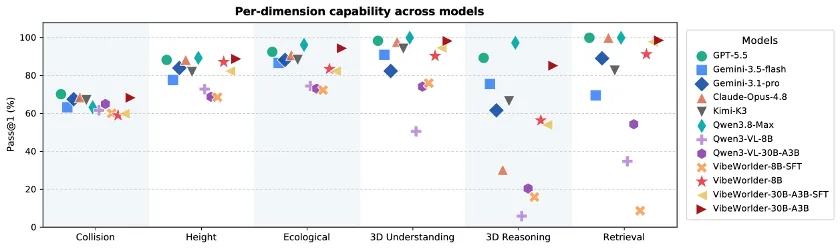
Figure 3: Pass rates across six capability dimensions for each model
The results are revealing: collision-free is the shared bottleneck for all models (including RL-trained flagships), with pass rates of only 59%~68% even after RL training. In contrast, RL most dramatically improves 3D reasoning capability — jumping from 6%~20% on base models to 56%~85%, with VibeWorlder-30B-A3B reaching 85%, surpassing Gemini 3.1-pro (62%). Retrieval capability is also boosted to 91%~99%, even exceeding frontier closed-source models. The conclusion:
RL dramatically improves the model's ability to "understand" scenes and "find the right" 3D assets, but the ability to precisely place 3D assets without collisions — this kind of fine-grained spatial manipulation — remains the shared ceiling for all current models (open or closed source).
Failure Mode Analysis: Two Most Typical Failure Patterns
To understand what makes "precise editing" so difficult, the team manually reviewed numerous failure cases and identified two most common and stubborn error types:
- Type 1: Imprecise 3D distance editing — wrong direction. The user asks to move a rock "forward 7 meters," the model correctly calculates the magnitude of displacement but gets the direction backwards, resulting in a 14-meter position error. This isn't a calculation error — it's a coordinate system misunderstanding.
- Type 2: Over-editing — accidentally deleting things that shouldn't be touched. The user only asks to "add a tree next to the box," the model correctly adds the new tree but during execution "conveniently" deletes an existing large tree from the scene — the plan was right, but the tool execution phase lacks sufficient state maintenance for "which elements shouldn't be touched."
Both cases point to the same conclusion: multimodal agents are already quite mature in semantic understanding, but have obvious shortcomings in precise spatial execution and cross-turn state maintenance — which the research team identifies as one of the most worthwhile future investment directions.
Vibe Worlding, Like Vibe Coding: A Usable CLI Prototype
To verify this system isn't just a "benchmark hunter," the team also provides a truly usable command-line interaction prototype paired with a browser-based real-time 3D render view — type a natural language instruction, the Agent immediately thinks, calls tools, executes edits, and the 3D world in the browser refreshes synchronously.
Scenario 1: Building a farm from scratch. User inputs "Create a simple farm with a barn, crop fields, fences, and a few trees." The Agent starts from an empty map, retrieves assets like barns, trees, fences, and crops, plans a three-zone layout of "farmhouse + fenced crop field + tree clusters," and self-corrects mid-way based on render feedback — lowering fence height when it looks like a wall, shrinking trees that are too large and blocking the farmhouse.

Figure 4: From-scratch construction — left terminal shows Agent's complete reasoning and self-correction process, right side shows the rendered farm in real-time
Scenario 2: Editing an existing city. Facing a busy city block, the user says "Remove the car in the middle of the road and delete the two green buildings." The Agent first enumerates skyscrapers, military buildings, cars, streetlights, and trees from the 3D map, precisely locates the target objects, fires three deletion calls, re-renders multi-view images to confirm "only the intended objects were deleted, everything else remains untouched," and finally summarizes the changes in natural language.
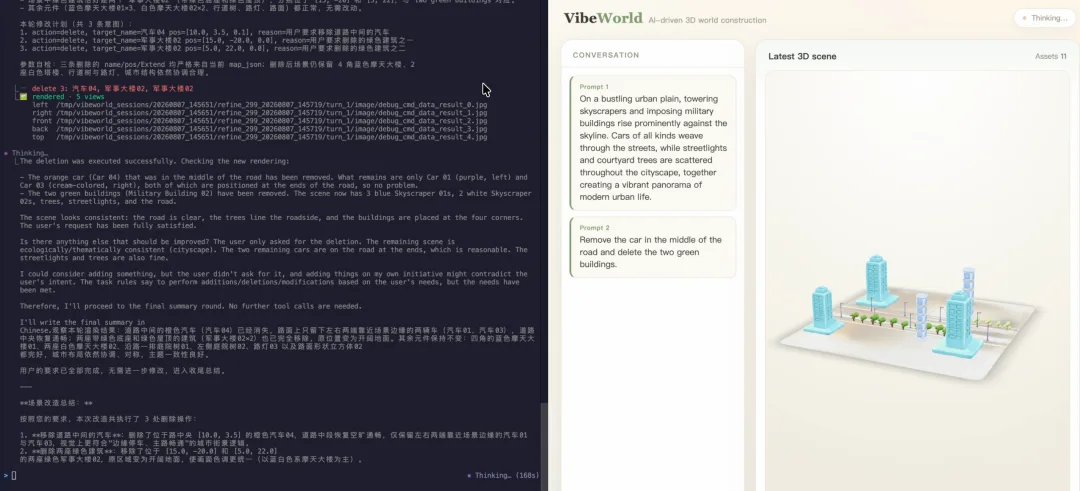
Figure 5: Multi-turn editing scenario — Agent locates and deletes specified vehicles and buildings while strictly preserving all other elements
The entire "think → execute → render-confirm → respond" closed loop is completely consistent with the multimodal feedback mechanism used in training. The research team has open-sourced this CLI prototype, hoping the community can build stronger agent frameworks and more professional skill plugins on top of it.
How Far Is True "Vibe Worlding"?
The paper lists several hurdles that still need to be crossed:
- Tools are too "atomic". The current sandbox only provides low-level operations like retrieve, add, delete, translate, and rotate. Future work needs higher-level, composable skills (like "pave a soccer field directly" or "randomly scatter a forest within a rectangular area") rather than assembling scenes piece by piece from low-level operations.
- Scene scale is still small. The most complex world in VWE-Bench has only 258 types of 3D assets. Truly open-ended world construction requires larger-scale scenes, possibly achieved through multi-agent collaborative division of labor.
- Outcome-oriented rewards are still sparse. Current RL training gives a single outcome reward per trajectory. Introducing more fine-grained process-level credit assignment in the future (e.g., specifically telling the model which round a collision occurred) could make training more efficient.
- Limited data sources and art styles. The current 3D asset library leans toward cartoon style, and doesn't yet cover richer multimodal settings like "image-to-world" or "video-to-world."
The deeper challenge is: even with a complete multimodal feedback loop, precise spatial reasoning capability (quantitative spatial relationships like distance and angle) remains a common weakness of all current MLLMs (whether RL-trained or not). The research team believes this may ultimately require injecting more 3D spatial data from the pre-training / mid-training stages to give base models truly solid spatial world understanding.
Wrapping Up
VibeWorlding's answer is not "3D world construction has been solved" — quite the opposite. The paper proves through experiments that even frontier closed-source models like GPT-5.5 and Qwen3.8-Max have overall success rates below 60% on this task. But it simultaneously proves something more important: as long as there are reliable verifiers and reward signals, open-source medium and small models can fully surpass closed-source frontier models through RL post-training — highly similar to the path "Vibe Coding" has traveled in the programming domain: first a sandbox environment with tools, then verifiable rewards, and finally open-source models catching up at scale.
Perhaps the "Vibe Coding moment" for 3D world construction is just beginning.